
Advertisement
Spanish crackdown has undermined Catalan independence bid, regional leader says
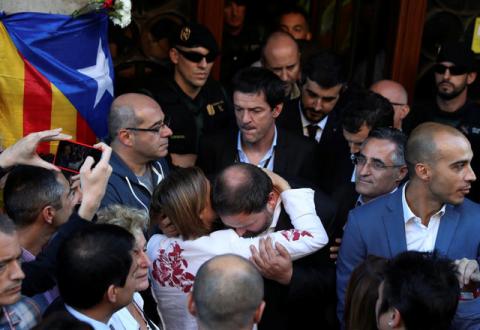
Catalan vice president Oriol Junqueras is embraced by president of Catalonian parliament Carme Forcadell outside the Catalan region's economy ministry building during a raid by Spanish police on government offices, in Barcelona, Spain, September 20, 2017. PHOTO BY REUTERS/Susana Vera
By Julien Toyer and Sam Edwards
21/09/2017
MADRID/BARCELONA (Reuters) - Catalan leaders acknowledged on Thursday that plans to hold a referendum independence from Spain on Oct. 1 had been undermined by the arrest of senior regional officials and the seizure of campaign material by national police.
The Madrid government, facing one of Spain's biggest political crises since the end of the Franco dictatorship and return of democracy four decades ago, has called the referendum an illegal act and taken police and court action to block it.
State police arrested Catalonia's junior economy minister, Josep Maria Jove, on Wednesday in an unprecedented raid of regional government offices.
Acting under court orders, police have also raided printers, newspaper offices and private delivery companies in a search for campaign literature, instruction manuals for manning voting stations and ballot boxes.
"It is obvious that we won't be able to vote as we would have liked," Oriol Junqueras, deputy head and economy minister of the regional government, told local television TV3. "They have altered the rules."
It was the first time the promoters of the referendum had acknowledged their plans were in doubt, although Junqueras said he was convinced voters would still turn out in numbers.
It is not yet clear whether the police operation would be enough to prevent the vote overall or if it could instead bring fresh momentum to the secession campaign.
Polls show about 40 percent of Catalans support independence for the wealthy northeastern region although a majority want a referendum on the issue.
Following Wednesday's raids by Civil Guards, tens of thousands of protesters had gathered outside the regional government offices in central Barcelona as well as in several Catalan cities, blocking streets.
DEMONSTRATIONS
Several hundred people, many waving the red-and-yellow Catalan flag, rallied on Thursday in front of the High Court of Justice of Catalonia to demand the release of the dozen officials arrested.
They packed the boulevard connecting Arc de Triomf and Parc Ciutadella, two popular tourist attractions, waving signs reading "Stop dictatorship" and "We want to vote."
Among them was Laura Aparicio, a 26-year-old student who was attending the protests with friends and planned to stay late.
"Like yesterday when we spent 12 hours in the streets, today we will stay until it is necessary. And on Oct. 1, we'll spend the day in the streets as well so that we are being heard," she said while showing a "Yes" sign.
"If we can't vote, we will vote in the streets," she said.
An anti-independence crowd rallied on Thursday outside the Civil Guards barracks in Barcelona holding up Spanish national flags.
The central government's spokesman said the protests had been organized by a small group and were not representative of the general feeling of the people.
"In those demonstrations, you see the people who go but you don't see the people who don't go, who are way more and are at home because they don't like what's happening," Inigo Mendez de Vigo said.
Mendez de Vigo also said an offer for dialogue from Madrid remained on the table. Repeated attempts to open negotiations between the two camps over issues such as taxes and infrastructure investment have failed over the past five years.
"MAINTAIN PROSPERITY AND UNITY"
Prime Minister Mariano Rajoy said on Wednesday the operations in Catalonia were the result of legal rulings and were to ensure the rule of law. He called on Catalan leaders to cancel the vote. "Don't go ahead, you don't have any legitimacy to do it. Go back to the law and democracy. This referendum is achimera," he said in a televised speech.
Hundreds of National Police and Guardia Civil reinforcements have been brought into Barcelona and are being billeted in two ferries rented by the Spanish government and moored in the harbor.
But the central government must tread a fine line in enforcing the law in the region without seeming heavy-handed.
Catalan regional president Carles Puigdemont tweeted on Wednesday night: "We will not accept a return to the darkest times. The Catalan government stands by freedom and democracy" -- an allusion the Franco era.
The stand-off between Catalonia and the central government also resonates beyond Spain's borders.
Spain's EU partners are concerned about the mounting crisis and their public support for Rajoy belies some disquiet that his hardline tactics might backfire.
In Scotland, Nicola Sturgeon, who heads the pro-independence devolved government, said she hoped the Catalan and Spanish governments could hold talks to resolve the situation.
"That has got to be preferable to the sight of police officers seizing ballot papers and entering newspaper offices," Sturgeon said.
In a referendum in 2014, Scots voted to remain within the United Kingdom but Scotland and Spain still keep a close watch on each others affairs. The Spanish government stridently opposed Scottish independence.
(Additional reporting by Elizabeth O'Leary in Edinburgh, Editing by Angus MacSwan)







Add new comment